
- Home
- Production services
- Production Company: Understanding Its Role and Choosing the Right One in France in 2026
Production Company: Understanding Its Role and Choosing the Right One in France in 2026

Description
What if the success of your next photo or film production came down to a single choice? Not a matter of budget, or even raw talent, but of partner. And yet, the confusion between a communications agency and a production company remains surprisingly common among decision-makers, even experienced ones. That lack of clarity leads to unexpected costs, poorly directed briefs, and sometimes disappointment at the end of the project. The truth is, photo and film production is not something you can improvise.
At Easy Spaces / Easy Production, our locations and production agency is built on one simple principle: the complexity of a shoot should not be your problem. This article gives you the keys to understanding how a production company really works, how to choose the right one, and why the shooting location is often the most underestimated decision in the entire process.
Key Takeaways
Understand the strategic role of an agency versus the executive and creative role of a production company. They are not part of the same value chain.
Master the key stages of audiovisual content creation, from pre-production to final delivery.
Identify the right criteria for choosing a partner that truly aligns with your brand universe.
Protect your projects: rights, insurance, logistics, everything people forget to ask before signing.
Understand why the set is not a detail, but often the first lever of a successful film.
What Is an Audiovisual Production Company?
A production company is the structure that turns a concept into images. It is not the one defining your brand positioning, that is the agency’s role. Production takes over once the concept has been approved: it executes, organizes with its local network, and manages the realities on the ground.
In practice, this covers very different worlds:
- Film and scripted content: feature films, series for streaming platforms.
- Advertising: TV and digital spots, often the most technically demanding projects.
- Corporate: institutional films, branded videos, executive interviews.
- Digital: short-form content for social media, which now represents the majority of commissions.
At the center of all this, the producer is first and foremost a project manager. They find the location, select the right equipment, coordinate the crews, and make sure the final file is actually usable. It is a job that is as much about facilitation as it is about creativity. Experience truly matters, and it sits at the core of every decision.
The Concrete Responsibilities of a Photo or Film Producer
First, budget management. A producer oversees budgets ranging from €10,000 for a digital content piece to several hundred thousand euros for a national advertising campaign. They also secure the legal framework: rights assignments, freelancer and crew contracts, production insurance. And they build the team, which requires a strong network and a real knowledge of the talent available on the market.
Delegated Production vs. Executive Production
The distinction matters, especially for your budget. The delegated producer carries the project’s overall legal and financial responsibility. They often hold the rights to the work. The executive producer, on the other hand, is the operational lead on the ground. They handle unforeseen issues and optimize day-to-day production costs. Bringing in a local executive producer for a regional shoot can significantly reduce travel and logistics expenses.
How Production Works: From Idea to Screen
A good production is won long before the first day of shooting. Anticipation is the real work. Everything happens before the shoot.
Pre-Production: This Is Where Everything Gets Decided
Pre-production takes up the largest share of a project’s total timeline. This is when the script or technical outline is written, the visual intentions are storyboarded, and the talent is cast. And above all, this is when the location scouting happens.
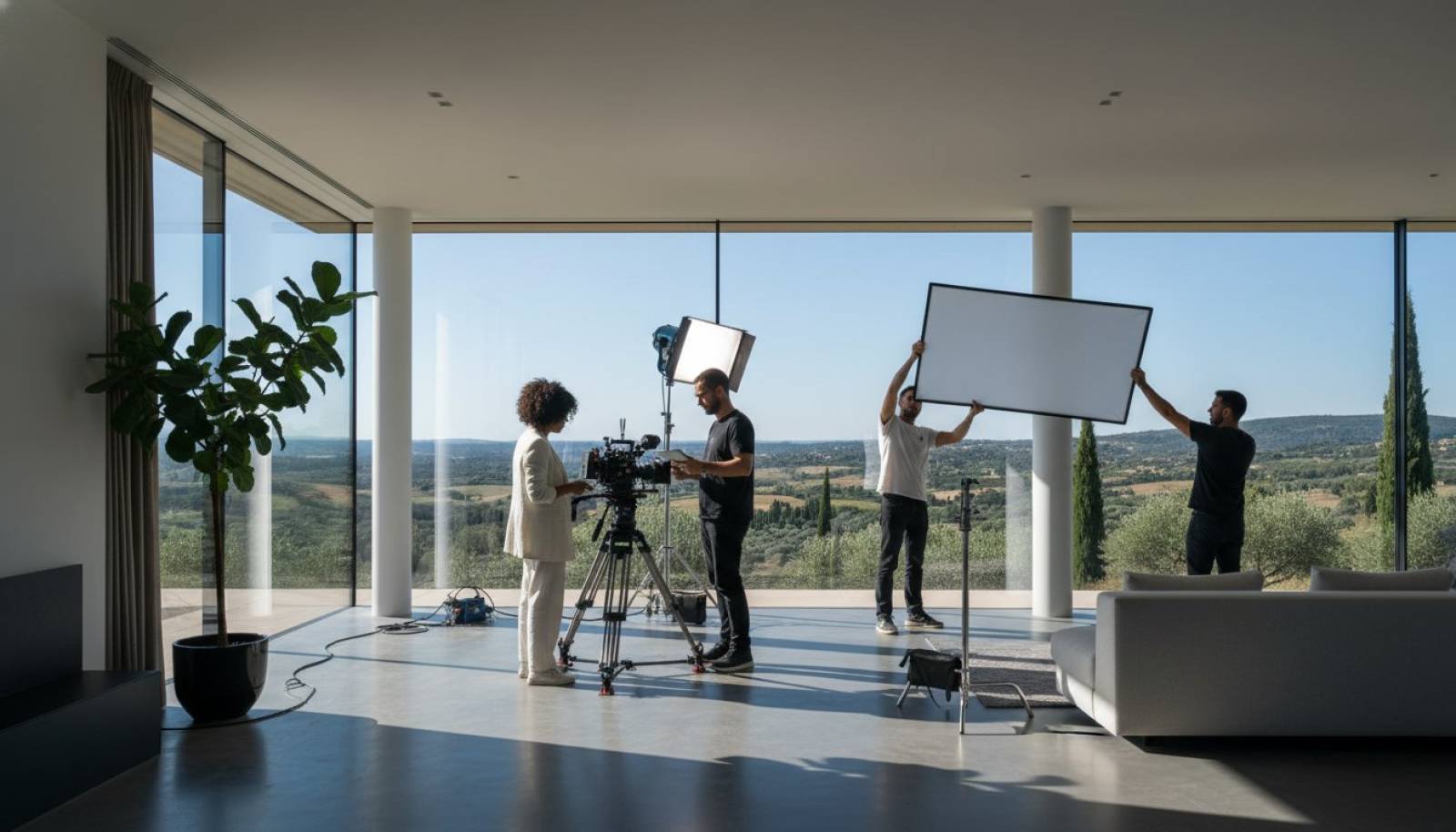
Choosing the location is the most strategic step in this phase. A well-selected space strengthens the message without artifice. Nothing needs to be added because everything is already there: the light, the volumes, the atmosphere. This is also when the technical team is assembled, camera, sound, hair, makeup, with availabilities that can sometimes come down to a matter of days.
Production: Execution Under Pressure
On set, everyone has a precise role. The director holds the artistic vision. The producer holds the schedule and the budget. The production crew coordinates the flow of operations: truck access, unloading zones, rest areas for the teams.
A shoot that has been well prepared logistically is a shoot that moves forward. Everything has to stay fluid. A poorly prepared shoot means hours lost solving problems that should have been anticipated three weeks earlier. Light and framing do the rest: a good cinematographer knows how to read a space and draw something out of it.
Post-production, editing, color grading, sound mixing, refines the result. But it does not fix a bad set. A location with real presence, one that tells a story on its own, reduces the need for digital retouching. The image stands on its own.
- Pre-production: total planning, from script to casting.
- Production: organization and technical execution, every minute counts.
- Post-production: refining emotion and rhythm.
- The set: the element that defines the project’s visual DNA before the shoot even begins.
Why Work With a Professional Photo/Film Production Company?
Handing a project over to a professional photo/film production company means offloading the logistical complexity so you can focus on what actually matters: the message.
An experienced director does not frame at random. They compose, anticipate the light, guide the eye, and tell a story. A seasoned team handles the unexpected without you ever hearing about it. That is the added value, and that is where experience truly comes into play.
In concrete terms, this gives you access to:
A network of specialized talent: cinematographers, art directors, stylists.
Cinema-grade equipment (RED, Arri cameras, etc.) used where it actually makes sense.
Schedule management that prevents budget overruns.
Your Brand Image Is on the Line
The perception of your company is shaped by the quality of your visual content. This is not about ego, it is a commercial reality. A clean image, well lit, in an environment that aligns with your positioning, says something about you before the first word is even spoken. A carefully chosen set is not just a set, it is an argument.
Operational Security and Peace of Mind
Unexpected issues are expensive. A single lost shoot day caused by poor logistical planning can exceed €12,000 for a mid-size crew. A professional production company handles image rights, administrative permits, and liability insurance. It is not glamorous, but it is what protects your investment and ensures the project is delivered on time and within a clearly defined budget that is monitored day by day.
How to Choose the Right Photo or Film Production Company
Start with the showreel. Not to admire it, but to assess it. Is their visual language compatible with yours? A company specialized in urban music videos will not have the same eye as a house used to luxury content. It is not a question of skill level, it is a question of visual culture.
Check their stability. In France, a significant share of audiovisual companies regularly face cash flow pressure. Ask for recent references and call at least two of them. Responsiveness is also measured before the contract is signed.
Ask for a detailed estimate, line by line: equipment, rights, post-production, contingencies. Hidden end-of-shoot costs are common. A good estimate makes them impossible.
The Criteria That Actually Matter
First, specialization. A company experienced in social content understands the codes of 9:16, short-form pacing, and subtitles. A house used to luxury knows how to handle complex lighting and elevate premium materials. It is not the same job.
Then comes the network. Do they have access to location scouts who can find places that are out of the ordinary? Do they have a strong database of scouting photos and private homes? Do they work with reliable regional partners?
And finally, the human fit. Six weeks of intense collaboration requires real mutual understanding. Not just politeness, trust too. Chemistry matters, and so does trusting your gut.
Getting Your First Brief Right
A precise brief saves time in pre-production, sometimes several weeks. Write down your KPIs (awareness, conversion, engagement), your delivery formats, and your schedule constraints. A shoot planned for spring 2026 should ideally start being prepared in January.
Also leave room for the producer. They know angles, locations, and options you have not thought of. That is why you are bringing them in.
Easy Spaces: The Preferred Partner for Production Companies
Finding the right set is often the first concrete obstacle in a production schedule. Easy Spaces exists so it does not have to be.
A Catalog Designed for Photo and Film Production in France
More than 1,500 referenced locations, selected as much for their aesthetic value as for their technical feasibility. Contemporary villas, industrial lofts, châteaux, unusual spaces, each listing details what production teams actually need to know: truck access, available electrical capacity, parking zones. Scouting moves faster because the information is already there.
An Offering That Goes Beyond the Location
Easy Spaces is not just a matchmaking platform. We coordinate, obtain permits when needed, sometimes complex ones in urban environments or protected sites, and facilitate the on-site reception of production teams:
- Rental of mobile dressing rooms and production vehicles.
- Access to technical equipment through our partners.
- Transfers and accommodation for crews and talent.
- Executive production for projects that require it, anywhere in France.
Proposal files are sent within 24 hours. Because production timelines do not wait. We know your time is valuable.
Take Your Audiovisual Projects to the Next Level
In 2026, delivering a successful film or advertising campaign requires precise coordination between creative vision and logistical execution. The production company you choose, the location you select, the team you assemble, every decision adds up.
Easy Spaces has been supporting image professionals since 2003. Our catalog of exclusive locations covers the entire country. Our executive production services take care of what needs to be handled so you can focus on what matters.
Find the ideal set for your next production with Easy Spaces.
Contact the Easy Spaces agency HERE and start getting help now.
Frequently Asked Questions About Production Companies
What is the average cost of hiring a production company?
Rates start at around €3,000 for a simple video and can exceed €65,000 for a premium advertising campaign. A large share of the budget goes to human resources: director, cinematographer, technical crew. The rest covers location rental and post-production.
What is the difference between a video agency and a production company?
The agency handles strategy and consulting. The production company makes the content. Most communications agencies subcontract the shoot to specialized producers precisely because they are two different trades.
How long does it take to produce a corporate film?
Between 6 and 9 weeks for a polished result. Count on two weeks of preparation and scouting, two to three shooting days, then several weeks for editing, color grading, and sound mixing.
Does a production company handle video distribution?
Generally, no. It delivers the technical files, sometimes adapted into short-form versions for social media. Paid media distribution falls under the role of a media agency.
Can you rent equipment only from a production company?
No. Production companies are not rental houses. Their equipment is reserved for their own projects. To rent specific gear, you should go through a specialized rental provider.
What is an executive producer and when do you need one?
This is the person responsible for on-the-ground logistics and financial oversight, acting on behalf of a client or another producer. They become essential as soon as the project involves a large crew or requires complex permits.
How can I protect my ideas before contacting a production company?
Have them sign a non-disclosure agreement before the first substantial exchange (NDA). You can also register your script with the SACD to obtain proof of prior authorship; the process costs around fifteen euros.
Why is the choice of shooting location so important for the budget?
The set represents roughly 20% of the total budget and directly affects the amount of work required in post-production. A naturally bright, visually strong location reduces the need for artificial lighting and digital retouching. It is an investment, not an expense.


Filming And Photo Shoot Production South Of France

Location Scouting for Photo and Film Productions in the South of France

Photo Production In Nice With Actress Uma Thurman