- Home
- Ideas & Advices
- Venue Hire and Exclusive Hire in Paris | Prices, Rules, Timings

Venue Hire and Exclusive Hire in Paris | Prices, Rules, Timings
Description
Venue hire and exclusive hire in Paris
Updated: August 2026
Paris hosts more professional events than any other French city, and competition for venues plays out over weeks, sometimes days. In 2024, the Île-de-France region hosted 367 trade shows, 589 international congresses and 1,356 other events (corporate, cultural and sporting), for 10.2 million attendees in total, according to the CCI Paris Île-de-France annual review. That is a substantial figure.
For an agency or a marketing department, this density cuts both ways. Supply is huge, which in theory means choice. But the most sought-after venues go early, price lists are opaque, and a poorly framed brief turns into three weeks of chasing.
This guide covers what you need before starting a search for venue hire or exclusive hire in Paris: the types of space actually available, the budgets observed on the market, the booking calendar, the regulatory framework, and a method for securing a venue without losing a month to it.
Hire or exclusive hire: two contracts, two logics
Standard hire covers a space made available for a defined slot, usually inside a venue that carries on operating around you. You occupy a room, a floor, a wing. The rest of the site stays live.
Exclusive hire closes the venue to the public for the full duration of the event. You get exclusivity over access, signage, sometimes the façade. The price absorbs the operator's lost trading, which explains the gap, particularly for a restaurant, a gallery or a rooftop.
That choice drives everything else: how far you can brand the space, control of the image, the number of guests allowed and the room you have on timings. A press launch with full brand dressing requires exclusive hire. A twenty-person board meeting has no need of it.
A third case comes up constantly with agencies: making a lived-in property available (loft, flat, hôtel particulier, architect-designed house) for a shoot, a film or a small-capacity event. Here the contract takes the form of a temporary occupancy agreement (convention d'occupation temporaire), with specific clauses on insurance, damage and the right to use images of the property.
The families of venue available for exclusive hire in Paris
The Paris stock reads by type rather than by arrondissement. Each family brings its own technical constraints and its own natural uses.
- Hôtels particuliers and reception flats: architectural character, capacities generally between 50 and 200 people, strong noise and neighbour constraints. Sign-off from the building's co-ownership (copropriété) is essential.
- Lofts, artists' studios and former factories: open volumes, ceiling height, raw floors. Ideal ground for modular formats, shoots and brand parties. Check the heating system if the event falls in winter.
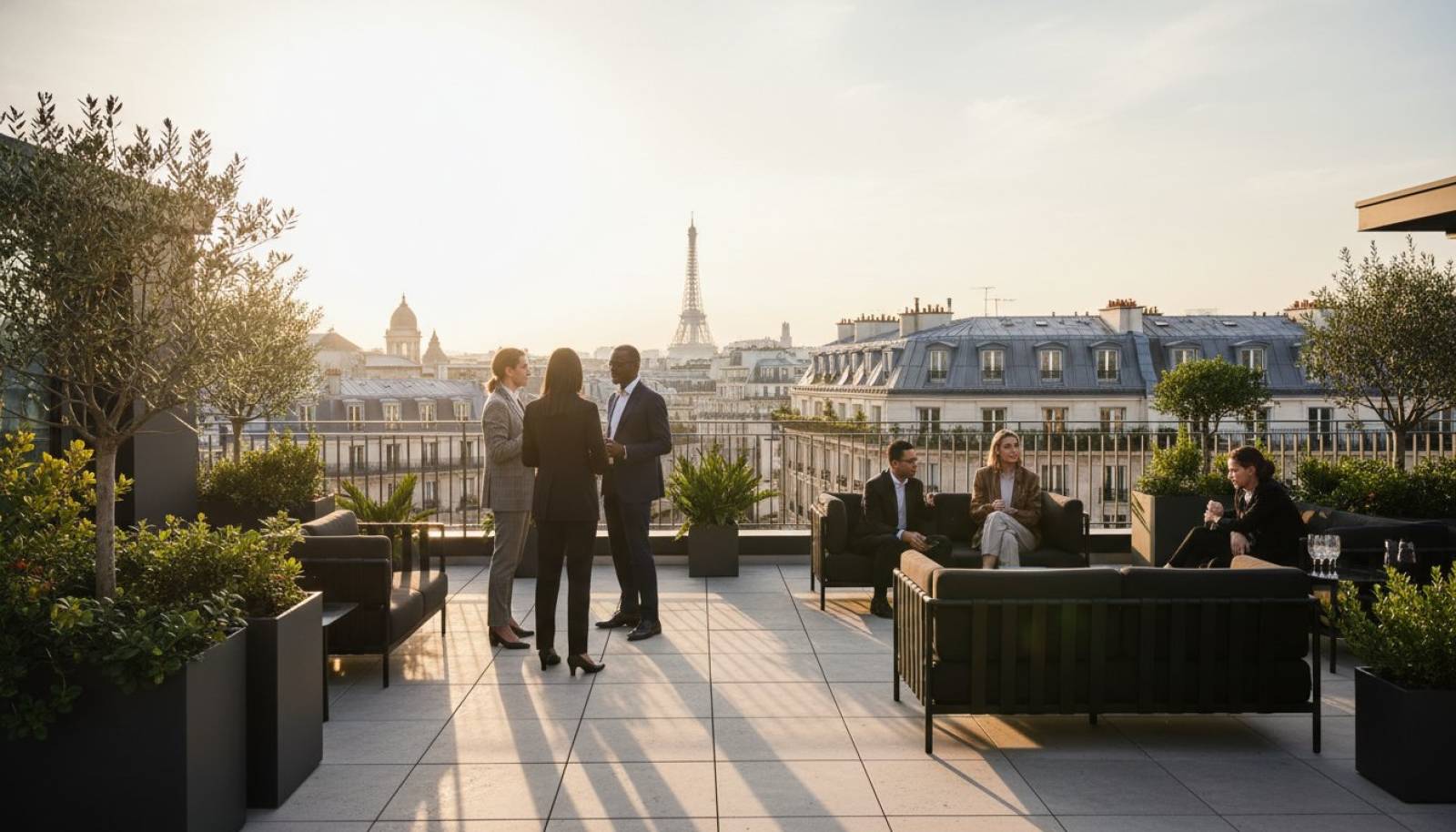
- Rooftops and terraces: heavily booked from May to September, weather-dependent, usually subject to a strict noise curfew. Check the ambient noise level if you are recording sound.
- Barges and boats: capacity set by the vessel's certification, boarding logistics to plan ahead, memorable effect guaranteed. Running an event on the water is still unusual enough to register.
- Galleries, showrooms and concept stores: white walls, controlled lighting, ideal for a product presentation, an exhibition or a road show.
- Heritage venues and museums: high symbolic value, long approval procedures, restrictions on fixings, catering and circulation. This type of venue can lack flexibility on timings, dates and access. Crews have to work around it.
- Dedicated event spaces and conference centres: technical equipment built in, high capacity, less scope for customisation, parking usually to be arranged in advance.
- Hotels and hotel rooftops: day rates per person, accommodation on site, useful for residential seminars.
The first move is to choose a type before choosing a district. An 80-person seminar with breakout workshops does not work in a partitioned hôtel particulier, however good the address.
What does venue hire and exclusive hire cost in Paris?
The ranges below come from observed Île-de-France market rates published by 1001Salles (2024 data, updated 2026). They cover hire alone, excluding catering and excluding technical services.
- Room for under 20 people: €150 to €400 excl. VAT per half-day, €280 to €750 excl. VAT per day.
- Room for 20 to 50 people: €350 to €900 excl. VAT per half-day, €600 to €1,800 excl. VAT per day.
- Room for 50 to 150 people: €600 to €2,500 excl. VAT per half-day, €1,200 to €5,000 excl. VAT per day.
- Two-day residential seminar: €150 to €320 excl. VAT per person, accommodation, meals and meeting room included.
- Exclusive hire of a reception venue for an evening: €800 to €8,000 excl. VAT depending on the site and the duration.
The add-ons often weigh more than the room itself. Budget €80 to €200 excl. VAT per day for a projector and screen, €8 to €15 excl. VAT per person per coffee break, €30 to €65 excl. VAT per person for a buffet lunch, €50 to €150 excl. VAT per day for a dedicated fibre connection.
For a corporate evening, the full cost per attendee sits between €50 and €160 excl. VAT for a standing reception, and between €90 and €240 excl. VAT for a seated dinner. A DJ or entertainment adds €500 to €3,000 excl. VAT, decoration €300 to €2,000 excl. VAT.
Three variables move the total significantly. Address first: rates in the 8th and 1st arrondissements run 30 to 50% above those in the 13th, 19th or 20th. Season next: the gap between September or October and January or February reaches 10 to 25%. Lead time last: a booking confirmed more than six weeks ahead can sometimes secure a 10 to 20% discount.
Reading the map by district
The 8th and 1st arrondissements sell an address. Triangle d'Or, place Vendôme, faubourg Saint-Honoré: right for a high-end client event or a product launch, expensive for an internal seminar.
The 9th and 10th offer the best compromise for many corporate projects: access via Gare du Nord and Gare de l'Est, plenty of hotels, rates more reasonable than in western Paris.
The 11th, 12th, 19th and 20th hold the lofts, studios and former industrial sites. This is where you find raw volume and ceiling height, at noticeably lower budgets.
The inner suburbs (petite couronne) remain a serious option when capacity goes beyond 200 people or when the budget is tight: rates there run 30 to 50% below intra-muros Paris. The deciding factor is not distance but real journey time from wherever your guests are gathering.
When to book: the real Paris calendar
The most in-demand venues book three to six months ahead. Standard spaces take four to eight weeks. Those lead times stretch for any date between mid-September and mid-December.
Bookings for end-of-year parties start in July. An agency launching its search in October for a mid-December evening is working a market that has largely gone, with the usual consequences for price and for the quality of what is left.
Quiet periods exist and are worth using: January, February, the second half of July and the month of August. A seminar moved from September to February can save a quarter of the venue budget without changing a line of the programme.
In practice, venue hire and exclusive hire in Paris turns as much on the date you pick as on the venue you choose. Shifting an event by two weeks often widens the shortlist more than raising the budget by 20%.
The regulatory framework
A privatised venue is still a public-access building. The ERP classification (établissement recevant du public), set out in articles R143-19 to R143-21 of the French construction and housing code, determines which safety obligations apply.
Categories are read by occupancy: category 1 from 1,501 people, category 2 from 701 to 1,500, category 3 from 301 to 700, category 4 up to 300, category 5 below the threshold specific to the activity type (often 200 people for a meeting room or a restaurant, 100 for a hotel).
The ERP type matters as much as the category. Premises classified W (offices) are not meant to host a 250-person dance party. Confirming that the intended use matches the venue's classification is the first check to run, before any price negotiation.
Above 300 attendees, pat-down searches at the entrance become mandatory and must be carried out by CNAPS-licensed staff, of the same sex as the person being searched and with their explicit consent. That line has to sit in the budget from the start.
Three further obligations come up every time. Organiser's public liability cover for the event and its suppliers. A SACEM declaration as soon as music is played, with 2026 rates between €62.50 and €340.86 excl. VAT per day for an event with background music, plus SPRE, generally calculated at 65% of the copyright fee. A temporary alcohol licence if you serve alcohol outside a licensed establishment.
For a film or photo shoot involving the public highway, the City of Paris requires an application through the AGATE platform at least fifteen working days in advance. That is a strict minimum. A simplified prior declaration, filed five working days ahead, is enough for a crew of under ten people shooting handheld with no vehicles parked. Since 1 January 2025, every first application must include a signed anti-harassment charter.
The method for securing a venue
- Write the brief before searching: exact capacity, format (seated, standing, workshops), date and time slot, venue budget separated from the overall budget, brand constraints.
- Check the ERP match between intended use and the site's classification, then ask for the safety register.
- Ask for the dimensioned floor plan and the ceiling height, not just the headline floor area. A 200 m² space with structural columns does not hold the same numbers as a clear floor.
- Check technical access: door widths, goods lift, whether a lorry can park, permitted delivery hours.
- Get it in writing what is included: cleaning, security staff, floor staff, furniture, sound system, available power in kW.
- Clarify the real build and derig hours. Access the day before changes the feasibility of a heavy build entirely.
- Get the cancellation policy and the payment schedule before signing, in particular the amount retained if you cancel within thirty days.
The mistakes that cost money
- Confusing floor area with capacity. Allow 0.8 to 1 m² per person for a standing reception, 1.2 to 1.5 m² for a walking dinner and 1.5 to 2 m² for a seated dinner.
- Ignoring the noise curfew, especially on rooftops, terraces and in residential areas. An evening that has to stop at 10 pm is not the same evening.
- Forgetting the available electrical supply. A staging setup, hot catering and a screen wall quickly exceed what a residential property can supply without a generator.
- Booking without a site visit. Marketing photos are shot wide and hide the columns, the level changes and the real state of the finishes.
- Underestimating permit lead times when the event spills onto public space.
Why work with Easy Spaces?
- A responsive team: substantial time saved on searching, shortlisting and dealing with owners. Venue selections sent the same day, matched to your brief and your budget. Receiving a selection is free.
- Secured venues: clear scoping of the requirement, validation, full handling of the paperwork (permits, contracts, insurance).
- End-to-end follow-up: we run the file from preparation through to the end of the occupation.
FAQ
What is the difference between hiring and privatising a space in Paris?
Standard hire gives you access to part of a venue that stays open around you. Exclusive hire closes the site to the public for your event and gives you sole use of it. Exclusive hire costs more because it compensates the operator for trading suspended.
How far in advance should you book a venue in Paris?
Three to six months for the most in-demand venues, four to eight weeks for a standard space. For a date between September and December, start the search in July. Confirming more than six weeks ahead sometimes opens up a discount. Talk to our team, it depends on the dates, the timings and the venue.
What budget should you plan for a corporate evening in Paris?
Between €50 and €160 excl. VAT per attendee for a standing reception, and between €90 and €240 excl. VAT for a seated dinner, all in. Hire alone accounts for €800 to €8,000 excl. VAT depending on the venue, catering €25 to €120 excl. VAT per person.
What permits are needed for a private event in a Paris venue?
Organiser's public liability insurance, a SACEM declaration if music is played, and a temporary licence if you serve alcohol. The venue must be ERP-classified for the intended use. CNAPS-licensed security becomes mandatory above 300 people.
Can you privatise a flat or a loft for a professional event?
Yes, provided the co-ownership rules and the classification of the premises allow it. These venues suit small capacities, photo shoots and filming. They are made available through a temporary occupancy agreement rather than a standard room hire contract.
Which Paris districts offer the best value?
The 9th and 10th arrondissements combine access and measured rates. The 11th, 12th, 19th and 20th hold the lofts and industrial volumes at contained budgets. The inner suburbs stay 30 to 50% cheaper than intra-muros Paris.
Looking for a venue for your next event in Paris?
If you have not yet found the space that matches your brief, we can send you free selections the same day.
Get in touch and send us your project: date, capacity, format, budget and brand constraints.
Our team replies quickly and stays with you through to production.
Venue hire and exclusive hire in Paris is a calendar exercise before it is a budget exercise. The earlier the brief lands, the wider the selection, and the more comfortable it is for everyone. That said, events do seem to be organised later and later.
Save time and get help today. Contact us now.
See you shortly!


An Exceptionally Charming Typical Parisian Gallery Perfectly Suited for Rent and High-End Events in Paris


Beautiful and Spacious Haussmannian Apartment Perfectly Located for Shooting and Filming in Paris


Event Venue Available for Rent in Paris Combining Elegance, Versatility, and Green Spaces